
'If individual stocks start falling 25% to 30% or more, then I doubt how many of them will be able to withstand that (kind of selloff). That is when you'll see panic coming in.'

Among the Sensex firms, UltraTech Cement, JSW Steel, Tata Motors, Bharti Airtel, State Bank of India, Larsen & Toubro, Infosys and Bajaj Finserv were the major gainers. On the other hand, NTPC and Tech Mahindra were the laggards.

India's prices are rising faster than many of its emerging market peers. The country's inflation print for May at 4.25 per cent is a marked reduction from the levels seen in May 2022 (7.04 per cent). However, even though the inflation rate remains within the Reserve Bank of India's medium-term target of 4 per cent, with a 2 per cent margin on either side, it continues to be higher than China, Russia, and Brazil.

India has not been able to compete with countries such as Bangladesh and Vietnam.

Summers dogged by controversies over past views

Among the Sensex firms, HDFC Bank emerged as the biggest loser, falling 4 per cent. JSW Steel, Reliance Industries, UltraTech Cement, Maruti, Tata Steel, Wipro, Tech Mahindra, Bharti Airtel and Larsen & Toubro were the other major laggards. Power Grid, Asian Paints, Sun Pharma, Axis Bank, NTPC, ITC and Infosys were among the gainers.

From the Sensex firms, Bajaj Finance, HDFC, HDFC Bank, Bajaj Finserv, Asian Paint, State Bank of India, Tata Consultancy Services, Bharti Airtel, Reliance Industries and Tata Steel were the biggest gainers. HDFC climbed 2.59 per cent after the housing finance major on Thursday reported a 20 per cent growth in standalone net profit to Rs 4,425 crore for the quarter ending March 2023 on the back of higher interest income. IndusInd Bank, Nestle, Power Grid, ITC, Tata Motors and Mahindra & Mahindra were the major laggards.

Among the Sensex firms, IndusInd Bank, Tata Steel, Tata Motors, Sun Pharma, Infosys, Mahindra & Mahindra, Infosys, NTPC, Bharti Airtel, HCL Technologies and Axis Bank were the biggest gainers. Tech Mahindra and Bajaj Finance were the laggards.

Equity benchmarks Sensex and Nifty faced heavy drubbing on Thursday, falling over 1 per cent each, in tandem with weak global markets following the US Federal Reserve's interest rate hike and its hawkish stance. The 30-share BSE Sensex tanked 878.88 points or 1.40 per cent to settle at 61,799.03. During the day, it tumbled 962.3 points or 1.53 per cent to 61,715.61.

Tata Steel, Tech Mahindra, NTPC, JSW Steel, Power Grid, UltraTech Cement, HCL Technologies and HDFC Bank were among the major gainers. Bharti Airtel, Hindustan Unilever, Axis Bank, Reliance Industries, Kotak Mahindra Bank, ICICI Bank and IndusInd Bank were among the laggards.

Investors' wealth soared by Rs 10.58 lakh crore in three days of the market rally, where the BSE benchmark jumped over 2 per cent, and hit an all-time high on Monday. Extending its winning momentum to the third day running, the 30-share BSE Sensex jumped 363.20 points or 0.49 per cent to settle at 74,014.55. During the day, it zoomed 603.27 points or 0.81 per cent to hit its record high of 74,254.62.

Federal Reserve chairman Ben Bernanke touched off the biggest one-day rally in US stocks this month by hinting that the Central Bank is almost done with raising interest rates. The indices had their biggest rise since June 29.

The Reserve Bank of India's interest rate decision, macroeconomic data and global trends will drive investors' sentiment this week, with markets hoping to continue the positive momentum after ending FY24 on a buoyant note, analysts said. In addition, the trading activity of foreign investors, the rupee-dollar trend and the movement of global oil benchmark Brent crude would also influence trading in equity markets. The 30-share BSE Sensex climbed 14,659.83 points or 24.85 per cent in the 2023-24.

Gold is an excellent asset class for diversification and should be included in all long-term portfolios.
With the first quarter earnings season coming to an end, the domestic equity markets would be driven by global trends and trading activity of foreign investors this week, analysts said. The movement of global oil benchmark Brent crude and the rupee against the dollar would also drive trends in the market. "Macroeconomic indicators, trends in global stock markets and FII activities will be pivotal in shaping market trends in the coming days," Pravesh Gour, senior technical analyst at Swastika Investmart Ltd, said.

Equity benchmark Sensex surged past the 57,000-mark by rallying over 1,000 points on Thursday, tracking an overall bullish trend in global equities despite the US Federal Reserve hiking rates. The 30-share BSE index closed 1,047.28 points or 1.84 per cent higher at 57,863.93. Likewise, the NSE Nifty surged 311.70 points or 1.84 per cent to end at 17,287.05.

Indian stock markets are expected to be driven mostly by global factors this week amid a lack of local triggers and earnings season largely coming to an end, say analysts. Crude oil prices, rupee movement and US Federal Reserve meeting minutes to be released this week will also influence the market sentiment. "With the earnings season behind us, global cues would largely dictate the trend in the coming week," Ajit Mishra, SVP - technical research, Religare Broking Ltd, said.

The rupee had plunged by 48 paise, logging its biggest fall in more than five weeks, to close at over one-month low of 61.13 against the greenback on Monday following demand for the US currency from importers.
ICICI Bank was the top gainer in the Sensex pack, rising over 3 per cent, followed by ITC, SBI, HCL Tech, Axis Bank, Bajaj Finserv and Tech Mahindra. NSE Nifty advanced 32 points to 15,856.05.

Foreign banks and private credit funds are queuing up to fund acquisitions by Indian companies who are buying out their local rivals. The Adani Group, Torrent Group, and the Hindujas have approached several foreign banks and private equity (PE) firms to fund their acquisitions. Global investors have about $2 trillion of funds to invest, and about $100 to $150 billion is set aside for India, according to an estimate by JP Morgan.

Markets end higher ahead of Fed outcome, China stimulus

There are already some signs of stress in this market.

The majority in the markets believe that a September lift-off is likely.
Equity markets rallied after softer-than-expected inflation data in the US and UK rekindled hopes of the end of the rate-hiking cycle by major central banks. The soft inflation reading drove down bond yields and the US dollar, whetting the appetite for risky assets. The 10-year US bond yield fell below 4.5 per cent after topping 5 per cent less than a month ago.
.jpg)
The partially convertible rupee closed at 63.37/38 per dollar compared with 62.83/84 on Monday. The unit dropped 0.85 per cent on the day, its biggest single-day fall in two weeks.

This was the weakest endorsement ever extended to a chairman in the central bank's 96-year history.

Expect heightened volatility and stress to hit the markets. Caution may be the need of the hour, alerts Akash Prakash.
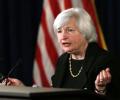
The Fed made clear that the rate hike was a tentative beginning to a "gradual" tightening cycle

Among the Sensex firms, HDFC Bank, Bharti Airtel, Infosys, UltraTech Cement, Tata Steel, Wipro, Kotak Mahindra Bank, Reliance Industries, Tech Mahindra and JSW Steel were the major laggards. Power Grid, Titan, Mahindra & Mahindra and NTPC were among the gainers.
Among the Sensex firms, ITC, NTPC, Axis Bank, Larsen & Toubro, Bajaj Finance, Asian Paints and Tata Steel were the major gainers. Mahindra & Mahindra, Wipro, Maruti, IndusInd Bank, Kotak Mahindra Bank and HDFC Bank were among the laggards.
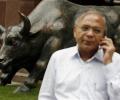
Rate-sensitive sectors like banks, auto and realty witnessed strong buying demand in trades today
The other prominent gainers were Tech Mahindra, HCL Technologies, Wipro, State Bank of India and Larsen & Toubro. Bajaj Finserv, Power Grid, UltraTech Cement and HDFC Bank were among the laggards.

After an extremely stable 2023, the Indian rupee started 2024 on a promising note and has turned out to be the best-performing Asian currency so far in January, appreciating 0.1 per cent despite 2 per cent rise in the dollar index. All other Asian currencies depreciated by around 1.4-4 per cent during the month. The local currency regained its ground against the greenback on the back of foreign portfolio inflows, said market participants.

64% of 800 investors polled think it will start this week but weak US data suggest it might not be aggressive.

Bharti Airtel was the biggest gainer in the Sensex pack, rising 2.37 per cent, followed by Mahindra & Mahindra, HCL Tech, Tata Motors, Tech Mahindra, HDFC Bank, Wipro, Tata Consultancy Services, Axis Bank and Nestle. Asian Paints, Hindustan Unilever, Bajaj Finserv and NTPC were among the laggards.

Elevated food price-led inflation could become a sore point for markets, which they seem to be ignoring at current levels, observe analysts. Retail inflation in India - as measured by the Consumer Price Index (CPI) - came in at a three-month high of 6.52 per cent in January 2023, compared with 5.72 per cent in December and 5.88 per cent in November 2022. The inflation print for February, according to Madan Sabnavis, chief economist at Bank of Baroda, will be critical for the Reserve Bank of India's monetary policy committee.

Investors' wealth eroded by Rs 6 lakh crore in a single day on Wednesday as the BSE benchmark Sensex tumbled over 790 points. The 30-share BSE Sensex fell by 790.34 points or 1.08 per cent to settle at 72,304.88. During the day, it slumped 872.93 points or 1.19 per cent to 72,222.29.

Rupee ends flat against dollar ahead of Fed policy outcome.

The deficit data was the latest in a run of positive signs for the sluggish domestic economy and could put India in a better position should the Fed start tapering, than in the summer when the rupee hit a record low.

Among the Sensex firms, Asian Paints, Tata Steel, HCL Technologies, Nestle, Maruti, JSW Steel, NTPC and Larsen & Toubro were the major laggards. Sun Pharma, Bajaj Finserv, Reliance Industries, State Bank of India and Bharti Airtel were the gainers.
